Pages

Minggu, 18 Maret 2012

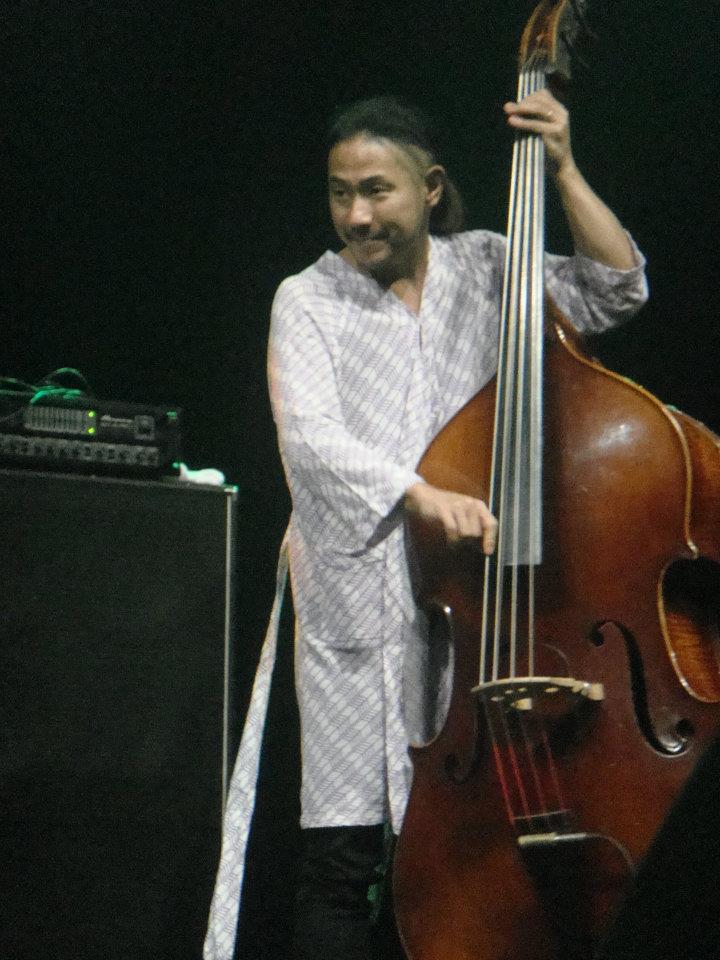
Soil and Pimp session


Soil & "Pimp" Sessions (stylised as SOIL&"PIMP"SESSIONS) is a Japanese club jazz sextet who formed in Tokyo, Japan in 2001.[1] They are known for their energetic live performances, having coined the term "death jazz" to describe their music.


Members

President a.k.a Shacho (久嶋識史), born January 18 1978 in Takefu, Fukui Prefecture - agitator
Tabu Zombie (椨智紹), born April 13 1977 in Kagoshima, Kagoshima Prefecture - trumpet
Motoharu (深田元晴), born June 29 1973 in Nayoro, Hokkaido) - saxophone
Josei (佐藤丈青), born October 30 1975 in the Saeki-ku Ward of Hiroshima, Hiroshima Prefecture - piano, keyboards
Akita Goldman (秋田紀彰), born July 8 1977 in Hachiōji, Tokyo - double bass
Midorin (緑川直人), born January 30 1978 in Iwaki, Fukushima Prefecture - drums


History

The band was born out of Tokyo's club scene, when Shacho and Tabu Zombie started including live jam sessions in DJ sets. Gradually the other members were invited, the band's line-up was finalised and the DJ sets dropped.
The band's adrenalin-fuelled live sets started to create a buzz on the Tokyo live scene, and in 2003 they became the first unsigned band to perform at Japan's Fuji Rock Festival. They were well received there and in the following months record companies were scrambling to offer contracts. JVC Victor won the battle, and summer 2004 saw the release of the mini-album Pimpin'.
The album was a critical and, for a jazz release, commercial success, and this together with constant touring paved the way for the release of their first full album, Pimp Master in early 2005. The album captures the sheer power of their live performances as well as highlighting their individual musical talents. Two tracks in particular, "Waltz For Goddess" and their cover of "A Wheel Within a Wheel", caught the attention of DJs abroad, and they began to receive heavy air-play on Gilles Peterson's Worldwide radio program on BBC Radio 1 in the U.K.
Summer 2005 was a busy time for the band, with the release of their second mini-album, Summer Goddess, and their first live dates outside Japan. Gilles Peterson invited them to play at Cargo in London, and Jazzanova invited them to play in Berlin.
They spent the rest of the year touring in Japan and Europe, and they were also featured in the live broadcast of the Gilles Peterson Worldwide Awards in 2005, where they were awarded the John Peel Play More Jazz Award.
A second full album, Pimp of the Year, was released in spring 2006, showcasing innovations that showed a development of their sound, as well as one or two tracks that marked a new departure.
2006 also saw the official release of Pimp Master in Europe on Compost Records and the UK on Gilles Peterson's Brownswood Recordings label. They continued touring constantly throughout the year, taking in Britain, Italy, France,Serbia, Belgium, Germany, Slovakia and Croatia, as well as an appearance at the Montreux Jazz Festival.
March 2007 saw the release of their third full album, Pimpoint, on the Victor Entertainment label, which features thirteen tracks.
Soil & "Pimp" Sessions' song "Paraiso" is the opening theme for the anime Michiko to Hatchin.
"Agitator" Shacho announced during their performance at the Relentless Garage in London that their latest album 6 was due for release on 26 April 2010 in the United Kingdom. No other release locations were confirmed by him at the time.
In 8 December 2010, Soil and "Pimp" Sessions released their album, "SOIL&"PIMP"SESSIONS Presents STONED PIRATES RADIO", containing 20 tracks. All of the tracks (aside from the occasional skit tracks) are covers, arranged in various ways using their style. From reggae to calypso to their aggressive jazz sound, you can hear tracks like "Walkie-Talkie Man," "Beat It," & "Imagine."
Around September 2011, they have announced that a new album will be released shortly, and that released was, "MAGNETIC SOIL", containing all new material of 15 tracks (except track 2 is their rendition of the Brecker Brothers' piece "Some Skunk Funk"), including a new version of the track "Summer Goddess."


http://en.wikipedia.org/wiki/Soil_%26_%22Pimp%22_Sessions
http://www.jvcmusic.co.jp/soilpimp/eng/profile/index.html


IS (Infinite Stratos)


IS (IS〈インフィニット・ストラトス〉 IS
is a Japanese light novel series by Izuru Yumizuru with illustrations provided by Okiura. As of April 2011, 7 volumes have been published by Media Factory under their MF Bunko J label. A manga adaptation by Kenji Akahoshi started serialization in the seinen manga magazine Monthly Comic Alive on May 27, 2010. An anime adaptation aired in Japan from January 6 to March 31, 2011, and an OVA was released on December 7, 2011. The anime is licensed by Sentai Filmworks in North America, and are planning to release the series in April 2012.


Plot

In the near future, a Japanese scientist engineers a powered exoskeleton called "Infinite Stratos" (IS). Possessing technology and combat capabilities far more advanced than any other weapon system, the IS threatens to destabilize the world. Faced with such an overpowering weapon, the nations of the world enact the "Alaska Treaty", which states that IS will never be used for military combat and that existing IS technology must be equally distributed to all nations, to prevent any one nation from dominating the others. The introduction of the IS does, however, have a major effect on society. As IS can only be operated by women, there is a shift in the power balance between men and women, where women now dominate society over men.
Ten years after IS was initially introduced, the world has entered a new age of peace. The peace is shattered, however, by an unexpected discovery. A 15 year-old Japanese boy, Ichika Orimura, is discovered to be capable of operating an IS. Realizing the potential, Ichika is forced by the Japanese government to attend the prestigious Infinite Stratos Academy, an international academy where IS pilots from all over the world are trained. Thus his busy high school life surrounded by nothing but girls who can use IS begins.

credit :
http://imageshack.us/photo/my-images/849/infinitestratos00000001.jpg/
http://en.wikipedia.org/wiki/IS_(Infinite_Stratos)

Sabtu, 18 Februari 2012

Un-Goは


Un-Go (アンゴ Ango?) is a 2011 anime television series produced by Bones which aired on Fuji TV's noitaminA program block between October 14, 2011 and December 23, 2011. Based on the noted Japanese intellectual and novelist Ango Sakaguchi's novel Meiji Kaika Ango Torimono-chō (明治開化安吾捕物帳?), the series is being directed by Seiji Mizushima and written by Shō Aikawa, who had earlier worked together on Fullmetal Alchemist.[1] Featuring character designs from pako and Yun Kouga, the music for the series is composed by Narasaki, with the opening theme being "How to Go" by School Food Punishment and the ending theme being "Fantasy" by LAMA. 


Plot

Based on the works of Ango Sakaguchi, the story follows Shinjūrō Yūki, a detective who solves mysteries with his strange partner, Inga. In a future Japan that has been affected by a major war and terrorist attacks after JSDF forces were deployed as peacekeepers abroad.


credit:
http://theawesomecritics.com/wp-content/uploads/2012/01/Un-go.png
http://en.wikipedia.org/wiki/Un-Go

Sabtu, 21 Januari 2012

家政婦のミタ(Kaseifu no Mita)


Synopsis

Mita Akari is a mysterious housekeeper who is completely unsociable. However, she is perfect in her housework and does whatever she is told, no matter how outlandish, as long as it doesn't involve smiling or revealing her past. She's been dispatched to the Asuda household where plenty of problems await, as the children have recently lost their mother and their father lacks confidence in his own role.


Cast
Matsushima Nanako as Mita Akari
Hasegawa Hiroki as Asuda Keiichi
Aibu Saki as Yuki Urara
Kutsuna Shiori as Asuda Yui
Nakagawa Taishi as Asuda Kakeru
Ayabe Shuto as Asuda Kaito
Honda Miyu as Asuda Kii
Nonami Maho as Kazama Mie
Sato Hitomi as Minagawa Mariko
Hiraizumi Sei as Yuki Yoshiyuki
Shirakawa Yumi as Arumi Akemi


Production Credits
Screenwriter: Yukawa Kazuhiko
Chief Producer: Tanaka Yoshiki
Producers: Ohira Futoshi, Ota Masaharu
Directors: Inomata Ryuichi, Sato Toya, Ishio Jun, Higurashi Ken
Music: Ike Yoshihiro


credit :
http://reviewdramajepang.files.wordpress.com/2011/12/kaseifumita.jpg
http://wiki.d-addicts.com/Kaseifu_no_Mita

Fate/stay night unlimited blade works


The television series was re-released in Japan on January 22, 2010 in two 60-minute special edition DVD/BD volumes to commemorate the release of the film Fate/stay night Unlimited Blade Works.[14] Fate/stay night TV reproduction I and II each recap 12 episodes from the anime and feature re-edited and re-compiled footage along with new opening and ending animation footage, with new ending songs by Jyukai and Sachi Tainaka. The opening song "disillusion -2010-" is a re-recording of the "disillusion" theme song from the television series.


Unlimited Blade Works: Infinite Creation of Swords (無限の剣製j(アンリミテッドブレイドワークス)
is the Reality Marble of Emiya Shirou and the Noble Phantasm of the Heroic Spirit Emiya and his Fate/Extra counterpart. Emiya doesn't have a true Noble Phantasm that is the crystallized embodiment of a hero's existence like many demonic or holy swords, but if a Noble Phantasm is considered to be a symbol of the Heroic Spirit, then the Reality Marble is his Noble Phantasm. It is high-class thaumaturgy that embodies their internal worlds and imprints them upon the world as a bounded field. It is their one true specialization of magecraft, the result of "Sword" being both their Origin and their Elemental Affinity, and the basis of their projection and reinforcement skills. It is the definite answer obtained by someone whose life was saved by a sword, actually merged and lived with a sword, and acted as a sword all of his life. Emiya has no penalties from the world while utilizing his version of Unlimited Blade Works.


Usage

Emiya's Unlimited Blade Works
Added by EGGS
Once the incantations have been completed, an illusionary fire that doesn't emit any heat spreads out to form a boundary and wall for the bounded field. The bright light fills the vision of those present, and manifests an open, barren desert with monolithic black gears gyrating in the distance. It is a kingdom of rubble littered with countless swords anchored in the ground like grave markers in a wasteyard. Shirou's version is bathed in twilight from the extended horizon, while Emiya's version has its view opaqued by a thick haze formed from embers and wisps of black smog produced by iron forging rising from the ground. Its purpose is a steel manufacturing factory that produces the countless famous swords without owners that extend into the horizon. It contains all of the raw materials and sorcery needed for the formation of the weapons, and it records and analyzes all weapons and defensive armaments encountered. The number of unique weapons encountered and recorded by Emiya exceeds numerous thousands, most of which are Noble Phantasms. Their entire histories, compositions, and designs are all perfectly recorded, allowing for instant proficiency with the weapons by inheriting all combat skills and techniques utilized by their original owners. This allows for the reproduction of Noble Phantasms, which would generally be impossible for a faker. They can also be modified to the user's taste with reinforcement as shown by Emiya's Caladbolg II and Kanshou and Bakuya.

Shirou's Unlimited Blade Works
Added by EGGS
Close combat weapons such as swords, spears, and halberds are the main focus of the Reality Marble in accordance with Shirou's Origin of "Sword", which also makes it impossible to record or reproduce modern weaponry like guns and other mobile weapons.[1] Shields and defensive armaments can be reproduced with a much greater struggle, as the cost in prana is high, two or three times greater than a sword, and the effects are merely transient compared to the originals. Weapons encountered are immediately analyzed with a single glance, enabling them to be projected immediately afterward, and once projected, they are stored within the Reality Marble for later use. Shirou is able to instantly recognize dozens of weapons being fired from the Gate of Babylon at an extremely high rate and instantly counter with projections of the same weapons before they can strike. Divine constructs, such as Ea and Excalibur, are unable to be replicated, though there may be degraded Noble Phantasms with similar abilities stored with the Reality Marble.[1] The construction of weapons is also limited to materials found upon the planet in the present era, so weapons like Ea, which is constructed from substances not found in the world, cannot be analyzed or reproduced. The analysis of weapons is limited only to the direct use of human senses, meaning that blueprints and materials will be unable to provide the necessary information for a proper analysis. Shared memories, such as dreams shared with a Servant, can allow for weapons to be analyzed and projected, even if they have been lost like Caliburn. The quality of projected weapons will always be degraded by one rank due to humans being unable to fully conceptualize the existence of an object through only one sense, and they will never equal the originals without a technique such as detonating them as Broken Phantasms. The one exception for Shirou is Avalon, which can be projected perfectly due to having been fused with him for many years.
Without being deployed, the Reality Marble allows for projection and reinforcement in the real world. Weapons are produced within Unlimited Blade Works and then brought into the world, greatly lowering the cost of reproducing them and allowing for numerous weapons to be prepared at once to be projected. Weapons can be summoned directly to the user's hands, or they can be summoned to levitate within the air and fire upon the enemy as arrows much like the Gate of Babylon. Once the Reality Marble is deployed, all of the weapons are available for use, and any weapon can immediately be called to the user's hands or levitated even while the user is in direct combat. The weapons reproduced once the Reality Marble is first activated will not consume prana, but those used or destroyed within it will add to the cost of maintaining the bounded field. The amount of energy used to reproduce weapons that did not exist after the bounded field was expanded and the amount of energy used to recreate weapons destroyed while it is activated is very costly. Emiya and Shirou have access to a large number of Noble Phantasms that they have encountered during their lifetimes, which include Caladbolg II, Durandal, Hrunting, Kanshou and Bakuya, Rho Aias, and numerous weapons from the Gate of Babylon. While it is not possible to reproduce Excalibur, Emiya claims that it is possible to reproduce an imperfect version likely to drain him of all of his prana in a suicide attack. Shirou using Emiya's arm in the Heaven's Feel route states that he would be able to project it if Saber Alter were to give him time, but believes that he cannot handle the sword and that the difficulty of doing such a high level projection in battle would make it impractical. He uses it at the cost of his life during the normal ending to destroy the Great Grail.

The Reality Marble is a natural counter to Gilgamesh, allowing Shirou, a below average magus, to completely overwhelm and defeat him. Though Shirou would be no match against other servants, who have mastered their own weapons to the utmost limit, the fact that both he and Gilgamesh are "owners" of numerous weapons places them on a level playing field. Neither has a specialized weapon with which they can be called a "wielder", so Shirou's ability to counter each and every weapon fired by the Gate of Babylon places Gilgamesh at as disadvantage. Outside of the Reality Marble, Shirou is barely able to keep up with Gilgamesh's assault while he was simply playing around with Shirou. Once within the confines of the Reality Marble, all of his weapons are produced and ready to attack, which means that the Gate of Babylon's slightly slower summoning rate allows Shirou to hone in on Gilgamesh to fight and defeat him at close range. He is unable to handle Shirou's attacks, which forces him to allows his own weapons to be destroyed in order to counter Shirou's projections, and Shirou even has time to instantly recognize Ea as Gilgamesh is drawing it and quickly chop off his arm before he can utilize it. Even with the advantages, he claims that Gilgamesh would win if he were to have time to regain his composure.


credit :
http://en.wikipedia.org/wiki/Fate/stay_night
http://typemoon.wikia.com/wiki/Unlimited_Blade_Works

Selasa, 10 Januari 2012

ベン・ト!終わった


Ben-To (ベン・トー Ben Tō?) is a Japanese light novel series written by Asaura, with illustrations by Kaito Shibano. The first volume was published in February 2008, and 10 volumes have been released by Shueisha as of December 2011. Shibano also illustrates two manga adaptations titled Ben-To Zero: Road to Witch and Ben-To Another: Ripper's Night. A 12-episode anime TV series adaptation produced by David Production aired in Japan between October and December 2011.


Plot

While innocently reaching for some half-priced bento, Yō Satō finds himself beaten up on the floor of a supermarket. He soon learns that getting half-priced bento is an all-out brawl between students. Yō is invited to the Half-Priced Food Lovers Club by one of the top fighters, Sen Yarizui, in order to train to compete in these battles.

credit
http://www.nerd-age.com/wp-content/uploads/2011/12/Ben-to-600x300.png
http://en.wikipedia.org/wiki/Ben-To

Jumat, 06 Januari 2012

Fate/zero 1st season


Fate/zero (フェイト/ゼロ Feito/zero?) is a prequel to Type-Moon's visual novel Fate/stay night. It is a light novel by Gen Urobuchi, illustrated by Takashi Takeuchi. The first volume was released on December 29, 2006, and is a collaboration between Type-Moon and fellow developer Nitroplus.[1] The second volume was released on March 31, 2007. The third volume was released on July 27, 2007. The fourth and final volume was released on December 29, 2007, along with the Fate/zero Original Image Soundtrack "Return to Zero". Four sets of Drama CDs were released from 2008 to 2010.


Plot

Fate/zero takes place 10 years prior to the events of Fate/stay night, detailing the events of the 4th Holy Grail War in Fuyuki City.[1] The War of the Holy Grail is a contest in which seven magi summon seven Heroic Spirits to compete to obtain the power of the "Holy Grail," which grants a miracle. After three inconclusive wars for the elusive Holy Grail, the Fourth War commences.
Founded by the Einzbern, Matō, and Tōsaka families centuries ago, the Einzbern family is determined to achieve success after three successive failures, no matter the cost. As a result, they have elected to bring the hated magus killer, Kiritsugu Emiya, into their ranks, despite his methods and reputation as a skilled mercenary and a hitman who employs whatever he can use to accomplish his goals. Though Kiritsugu had once wanted to become a hero who could save everyone, he has long since abandoned this ideal upon realizing that saving one person comes at the cost of another's life. For the sake of humanity, he will ruthlessly destroy anything and anyone who threatens the peace of others.
However, Kiritsugu finds himself deeply torn between the love he has found for his new family - his wife Irisviel and their daughter Illya - and what he must do to obtain the Holy Grail. Meanwhile, Kiritsugu's greatest opponent appears in the form of Kirei Kotomine, a priest who cannot find any sense of fulfillment in his life and sets his sights on Kiritsugu as the possible answer to the emptiness he feels.


credit:
http://en.wikipedia.org/wiki/Fate/zero